Showing posts with label reviews. Show all posts

Sunday, May 22, 2016

Benedict Cumberbatch proves a superb villain in The Hollow Crown's Richard III

THE GUARDIAN
Michael Billington
@billicritic
Saturday 21 May 2016 18.10 EDT


 The camera is a close bosom friend … Benedict Cumberbatch as Richard III. Photograph: Robert Viglasky/BBC/Carnival Film & Television Ltd


Richard III brings the BBC’s Hollow Crown cycle to a fine climax. It also confirms that Benedict Cumberbatch is a highly physical, as well as a natural Shakespearean, actor. Watching him wrestle his way into his clothes in the opening soliloquy, I was reminded of his superb performance as the creature in the National Theatre’s Frankenstein. On stage, we witnessed the tortured birth of a monster; here we see Richard acquiring a new identity as he gets laboriously dressed.

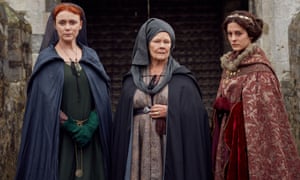
Keeley Hawes as Elizabeth, Judi Dench as Cecily and Phoebe Fox as Anne.

Cumberbatch starts with two great advantages. The previous episode enabled him to lay the ground for Richard’s throne-hungry mania. Like Olivier in the film of Richard III, he also uses the camera as a close bosom friend. Having wooed Phoebe Fox’s Lady Anne – an episode that here takes place in a forest glade – he confides to the camera, and thereby to us, his rasping astonishment at her pliability.

In fact, Cumberbatch takes us stage by stage through Richard’s systematic progress to power. The dominant image of the production is of Cumberbatch’s index finger tapping a chessboard, as he works out how to remove the pieces that stand between him and the crown. But it is a mark of Shakespeare’s progress that the dramatist also allows us to see inside Richard’s soul: Cumberbatch is especially good in the eve-of-battle soliloquy, where a character who might simply be a murdering monster pathetically realises “there is no creature loves me”.

Although Cumberbatch dominates the screen, this is far from a one-man show. Judi Dench brings all her clarity of speech and matchless sincerity to Richard’s mother, who views her son with undisguised horror: when she asks “What comfortable hour canst thou name / That ever graced me in thy company?” you totally believe her. Sophie Okonedo’s Queen Margaret stalks the action, right up to the climactic battle, like a vengeful ghost. Keeley Hawes turns Queen Elizabeth into a helpless pawn in Richard’s power games. Anyone who has seen the previous episodes will also understand – in a way that is tricky when the play is seen in isolation – just what the women are talking about when they catalogue Richard’s endless crimes.

READ MORE: http://www.theguardian.com/stage/theatreblog/2016/may/21/benedict-cumberbatch-the-hollow-crown-richard-iii

Sunday, September 23, 2012

Downton Abbey, ITV1, Review Ben Lawrence reviews episode two of ITV1's Downton Abbey, series 3. (THE TELEGRAPH) (SPOILERS)


Some Downton fans might have felt cheated by the beginning of this second episode. Previously, Matthew (Dan Stevens) and Mary (Michelle Dockery) had been left precariously at the altar before vows had been exchanged. Could Matthew, who had been showing hints of socialist sympathies, suddenly have decided not to marry into the aristocracy? Could there have been a Jane Eyre-style intervention when the congregation were asked for any just cause why the union should not take place?

As it turned out, Matthew and Mary were married, but we were never treated to the “I do” moment. Or that binding kiss. Instead we saw Matthew and Mary returning from their French honeymoon and being quite the continental couple. Matthew felt embarrassed by lady’s maid Anna seeing him “en deshabille”, and the episode was peppered with other French phrases. Even American Martha (Shirley MacLaine) was at it: “Yachts were his idée fixe,” she said of one relative.

READ MORE: http://www.telegraph.co.uk/culture/tvandradio/9557955/Downton-Abbey-ITV1-Review.html

Friday, July 6, 2012

Review: Henry IV Parts 1 And 2 ReviewsTom Hiddleston and Simon Russell Beale are utterly spellbinding. Posted 5th July 2012, 4:44pm in TV, by Christa Ktorides (DIY)


Please note that if you do not know your Shakespeare or your English history then there will be spoilers below.

Following on from last weekend’s triumphant screening of Richard II on BBC Two, we were fortunate enough to attend a screening of Henry IV parts 1 and 2 at the BFI Southbank. Having now seen all four films of Aunty Beeb’s ambitious retelling of four of Shakespeare’s historical plays – the Henriad tetralogy – on the big screen we pity those of you that will only see them in the living room for they make for truly beautiful cinema.

With Henry IV parts 1 and 2, Rupert Goold (Richard II) hands over the director’s reigns to Sir Richard Eyre, a man who knows exactly what to cut from the text and what is essential to leave in. He also has a knack for rearranging scene order for the sake of television, understanding the medium entirely.

Rory Kinnear has grown up to be Jeremy Irons (Henry IV). He’s also a bit of a grump, despairing at the behaviour of his flightly playboy son Prince Hal (Tom Hiddleston). Hal you see would much rather be hanging out in the grimy bars of Cheapside with his cronies Falstaff (Simon Russell Beale) and Poins (David Dawson) than getting involved in matters of state.

When a rebellion against the King, led by the charismatic Hotspur (Joe Armstrong) comes to light, Hal must begin to face his responsibilities as heir to the throne and prove himself on the battlefield.

This is sexy Shakespeare with Eyre knowing a handsome chap when he sees one, making Hal a leather jacket sporting sexpot who likes a sauna (yes ladies, there's a scene in a sauna). He might be a bit of a soak (quite literally at one point as he’s covered in red wine) and if it were a modern tale he’d be that loud rugger bugger at the end of the bar, guffawing with his pals and ruining your evening but Eyre and Hiddleston make him a desirable devil, one that has our loyalties from the get go. The famously infectious Hiddleston laugh is in evidence throughout and Eyre wisely keeps the focus on Falstaff and Hal for the majority of Part 1, the rebellion of Hotspur taking something of a backseat so as to establish the characters of our drinking buddies and making the eventual dismissal by Hal of his former partner in crime all the more emotional come the close of Part 2.

Russell Beale nabs all the best lines as Falstaff but it’s what goes unsaid behind his eyes that truly connects with the audience, it’s Hal’s love he craves above money and status and yet the old rascal is his own worst enemy and Russell Beale, looking uncannily like Billy Barty in Masters of The Universe, amps up the naughtiness and self-serving nature of Shakespeare’s most amusing character to a Spinal Tap 11. It's worth noting too that Hiddleston can muster up a seriously great Jeremy Irons impression. Part 1 is something of a merry jape for a good portion of its running time. Hiddleston’s Hal is good company indeed, his back and forth’s with Russell Beale’s lovable rogue Falstaff a delight to behold.

READ MORE: http://www.thisisfakediy.co.uk/articles/television/review-henry-iv-parts-1-and-2/

Monday, January 9, 2012

Downton Abbey Review: Welcome to WWI (TV Fanatic)

Tag:
The season 2 premiere of Downton Abbey reminded us why the Crawleys are kind, considerate and compassionate people, genuinely interested in everyone around them. Their own livelihood, that of their town, their country, their home and their staff are all equally important. That they take nothing for granted is unique in a story of this type and makes them utterly charming.

From the moment Matthew and his mother stepped foot onto Downton Abbey, I fell in love with them. But I didn't realize how much I cared for Matthew until I saw him on the WWI battlefront in the opening scene. As the third cousin once removed and heir to Downton Abbey, what could have been a painful situation for the family turned into one of mutual respect and admiration, as he and Isobel proved themselves worthy to the task of looking after the Abbey.

Going to War

Whereas the sinking of the Titanic put Matthew into a position he could never have dreamed at the start of the series, his own life is now in jeopardy as he fights for his country, beside the very same people he had come to know as household help just two years earlier. It's an extraordinary sequence of events demonstrating how easily circumstances can change for any one of us, no matter our position in life. That the residents of the Abbey treat each other justly works in their favor because their situations continue to transform.

If ever there was a catalyst for transformation in Europe, World War I was it. The Abbey is left with few men on staff, and the Earl of Grantham himself is embarrassed to be dismissed from active service and used merely as a morale booster in the war effort. Still, not understanding of the changing times, Violet has taken it upon herself to ensure the Abbey is not completely without man-servants by using her station to speak with the local Army doctor about medical conditions she believes would keep some male staff from duty.

It was particularly upsetting to learn of this hidden deal when two women attending a fundraising concert at the Abbey stood up and handed out white feathers signifying cowardice to the young men left behind. With Isobel hard at work on the war effort and her own son in the trenches, once she learned of Violet's deception, she demanded that each man be evaluated on their own merit for service. Only Mr. Mason begged release.

It was no surprise that Sybil felt so greatly the need to assist in the war effort. After speaking her mind to Isobel, the latter suggested she learn some things from the help - such as how to make her own bed, clean the floors and learn cooking skills so she would have talents to start with in the nursing career. That she wouldn't know how to do those things never entered my mind, but it was absolutely joyful watching her in the kitchen. The richness of the household relationships was at its best during those scenes.

Mr. Carson felt he needed to let Cora in on the secret, and the love on her face as she watched Sybil successfully remove a cake from the oven that was to be a surprise for her mother was beautiful. I assume it's because Sybil is their youngest child and the decision to tackle nursing meant leaving the Abbey is why Carson was so concerned about Sybil's desires... because Edith was busily learning to drive in the event William was called to war and they were in need of a chauffeur. Although her driving caused much laughter, it didn't cause any other undue concern.

Mary's engagement was to be the family's salvation of Downton Abbey, and when her fiance died on the Titanic and Matthew was introduced, everyone naturally thought they would make a match. But she was used to getting what she wanted, and at that moment in time it wasn't Matthew. A dalliance ending in the death of a suitor is still causing ramifications for the Abbey years later. Because of Edith's jealousy, what could have remained a household affair became a scandal on the national level. Now it's Anna's turn to suffer for her role in the affair.

After returning from his mother's funeral, Bates believed his estranged wife, Vera, would finally grant him a divorce and that the love he shard with Anna would be allowed to bloom. Before asking her to marry, he asked Robert for a nearby cottage so they could continue their service at the Abbey.

Unfortunately, when his wife went to find a job of her own, they mentioned the scandal and Anna's role in it.

Seizing the opportunity, Vera made way for Downton Abbey, demanded John remain married to her and leave the Abbey immediately lest she throw the entire Abbey under the bus, so to speak. Anna was devastated, Robert was distraught at the loss of his friend and Bates fell on his sword to save those he loved from any harm at the hands of his wife.

In one of the most surprising turn of events, we learned Matthew had been visiting London but had not come to the Abbey when he had time off of the lines. During those visits, he had fallen in love and become engaged. On the occasion of the concert, he decided it was time to bring his fiance home and introduce her to the family. It was also time for he and Mary to mend fences. Mary acted as though she was happy for him, but the love everyone once thought inevitable had indeed peaked, but it was too late.

She saw him off at the train station and Matthew asked her to look after his mother should he not return, as well as his fiance, Lavinia. Mary had been her own worst enemy, but once she understood what she felt for Matthew, she wouldn't let him return to the front without giving him something to think about during battle.

Carson gave Mary advice to tell Matthew what she feels for him, in case the worst happens and in the event it might change his mind about Lavinia. My advice to her would be not to invite newspaper magnates as potential suitors when Matthew is around, although Sir Richard was refreshing in his lack of social skills. None any of this changed the circumstances of how Mary or Matthew felt, nor did it explain how Richard and Lavinia knew each other. Something odd is definitely afloat.

Elsewhere, Sybil was working at the hospital and Lady Cora arranged to have an injured Thomas reassigned there as well. When they were forced to send a soldier away from before he was ready to go, he committed suicide and the savagery of the act opened the door of Downton Abbey to become a convalescence home for recuperating soldiers.

Other thoughts:
  • Mr. Carson's nasty attitude finally caught up with him. He had what would now be called a panic attack during a dinner party. He refuses to let maids do the work of footmen, even when there are no footmen available. All he does is complain and then he wonders why he gets flustered.
  • It was a hoot watching Edith pull a giant tree stump out of the ground with a tractor when she went to work at a neighboring farm. After the giant fuss she made over Mary's indiscretion, she's kissing a married man? It got her fired.
  • How awful was it that Mrs. Patmore's nephew was shot for cowardice? I can't even imagine receiving that news.
  • Am I the only one who thinks William looks just like the a grown up Charlie from Willie Wonka and the Chocolate Factory (original)?
  • I can't imagine feeling for someone what Anna feels for Bates. To be so deeply and surely in love. How wonderful that must be, even having been separated.
  • Miss O'Brien's constant toying with new maid Ethel was mean and I'm glad it let up somewhat by the second hour.
Things are sure to remain highly engrossing as we follow the upstairs and downstairs Abbey residents moving through World War I. Come back next week for the second installment of this season's Downton Abbey.

http://www.tvfanatic.com/2012/01/downton-abbey-review-season-2-premiere/


Sunday, October 9, 2011

A WONDERFUL REVIEW FOR THREE MUSKETEERS

By Padraic McKiernan, Aine O'Connor and Hilary A White

Sunday October 09 2011

The Three Musketeers 3D
Cert: 12A

SO much for fortune favouring the brave. The historical backdrop against which Hollywood's latest take on The Three Musketeers is played out, points to a world where fortune very much favours the knave. At least during the initial scenes.

As described in an opening voiceover, Europe is a "powder keg", while France, assailed on all sides, is under the reign of a feeble king, Louis XIII. He is but a pawn in a power grab being hatched by Cardinal Richelieu (Christoph Waltz) and his partner in treason, M'lady (Milla Jovovich).

The call goes out for the Three Musketeers, but alas, all is not as it could be with France's most faithful. A couple of setbacks have left Athos (Matthew Macfadyen), Porthos (Ray Stevenson) and Aramis (Luke Evans) submerged in self-pity and lacking in motivation. Cue swoons all round with the appearance of the dashing d'Artagnan (Logan Lermon) who proves that chivalry isn't dead. The four join forces for a swashbuckling storyline involving missing diamonds, double agents and double entendres.

Top-notch casting and impressive special effects create a film that will keep fans of good-quality blockbuster entertainment enthused. Collectively, these musketeers generate an engaging and likable screen presence while the hunktastic Lermon anchors proceedings brilliantly. Director Paul WS Anderson's tongue-in-cheek tone also sustains strong engagement levels for the duration. A case of all for fun and fun for all, then? Certainement.
PMcK