Showing posts with label Marilyn Monroe. Show all posts

Monday, March 12, 2012

Interview: Actor Kenneth Branagh (My Week with Marilyn) (EXAMINER)

(My husband Richie and I saw this movie and we loved it!)


Joseph Airdo
Phoenix Movie Examiner

Upon reading Adrian Hodges' screenplay for “My Week with Marilyn,” actor Kenneth Branagh became interested in the project primarily because it did not take the route of a conventional biography about Marilyn Monroe or Sir Laurence Olivier.

“I thought that it was very clever in the way that it took a single snapshot of a moment in their lives where there are lots of incidents that were revealing about their characters,” Branagh said during a recent interview with Examiner.com. “It offered a chance to look behind the public, iconic faces of these two characters and get a sense of who they could be and what their problems and challenges were like, which I feel to be very human, vulnerable and recognizable.”

In “My Week with Marilyn,” which will be available beginning Tuesday, March 13, Eddie Redmayne plays Colin Clark, a production assistant who introduces Monroe (Michelle Williams) to the pleasures of the British countryside during the filming of “The Prince and the Showgirl.” Branaugh plays Olivier, that film's director and Monroe's co-star.

“I very much enjoyed the detective work,” said Branagh, noting that he watched as many films and interviews featuring Olivier during that time in his life in order to get into character. “We went to great pains to get the right hair color and to get the eyebrows arched the way that his were. Then we came up with this prosthetic piece that would allow for this little cleft in his chin as this very striking, familiar feature of his face.”

In fact, Branagh said that his experience planning for the part was so immersive that he felt as though he was attending “Olivier University,” so to speak. Meanwhile, the actor added that simply walking on the set was a very intoxicating experience that essentially felt as though he had traveled through time. After all, “My Week with Marilyn” was shot on the same sound stage as “The Prince and the Showgirl.”


READ THE REST OF THIS INTERVIEW:  http://www.examiner.com/movie-in-phoenix/interview-actor-kenneth-branagh-my-week-with-marilyn


Saturday, March 3, 2012

Kenneth Branagh channels Olivier (BUSINESS WORLD WEEKENDER)


BY ANGELA DAWSON,
Front Row FeaturesHOLLYWOOD --

Early in his career, Kenneth Branagh sent a letter to his idol Sir Laurence Olivier asking him for advice on a role he was about to play.

“That, in itself, was exciting: the ritual of writing to a god,” recalls the renowned actor and filmmaker some 30 years later. “That’s what it felt like ” writing to a god with an address in central London.”

More nerve-wracking than actually sending his query to the famous performer was actually receiving a response from him. “I remember my hand shaking when I got the envelope,” Branagh says, recounting the tale like an old storyteller. “On the back it said, ‘Laurence Olivier’ in embossed, raised lettering.”

The young thespian struggled for several minutes on how best to open the envelope without doing too much damage to it. He looked around for a letter opener but couldn’t find one. So he finally just tore open the flap and pulled out the typewritten letter on fancy blue letterhead.

 It read: I’m afraid I cannot give you any advice in particular ways in which you should approach this role. It’s up to an actor himself to come up with these individual things. But my advice to you anyway is to have a bash and hope for the best, which I certainly wish for you.

Branagh never met the renowned movie and stage actor, who died in 1989, but he kept the letter, which remains one of his prized possessions. Holding Olivier in such high regard, Branagh paused when he was offered the opportunity to portray him in My Week With Marilyn, a possibly true account of a young stagehand’s relationship with Marilyn Monroe during the production of The Prince and the Showgirl, which was directed and co-starred Olivier.

Read further:  http://www.bworldonline.com/weekender/content.php?id=47624


Tuesday, February 28, 2012

Kenneth Branagh upset about loss - not the Oscar, Arsenal in the London derby (SHOW BIZ SPY)


“To be honest I’m more upset about Spurs losing than me,” said Kenneth. “I never expected to win anyway but Arsenal in the London derby was a different matter. I’m devastated.”

The British star has revealed a prosthetic chin helped him achieve some sense of Sir Laurence for the movie about Marilyn Monroe‘s time in the UK filming The Prince and the Showgirl. “The chin piece definitely helped a lot,” says Kenneth. “Olivier had an imperious quality to him. He was used to playing a leader, he was used to playing kings, he was used to being the boss.

Read more:  http://www.showbizspy.com/article/244704/kenneth-branagh-upset-about-football-result.html

Saturday, February 25, 2012

Michelle Williams wins Spirit Award for portrayal of Marilyn (UPI.COM)

Directed by Simon Curtis, the film is based on the memoir of Colin Clark, an assistant director on the 1957 film "The Prince and the Showgirl" who showed Monroe around England when she was there shooting the movie with Laurence Olivier, a classically trained actor and director alternately amazed and frustrated by Monroe's talent, substance abuse, insecurity and Americanized approach to acting.

Williams plays the troubled sex symbol in the film version of Clark's book, while British actor Eddie Redmayne plays Clark and Northern Irish Oscar nominee Kenneth Branagh plays Olivier. "I'm not a singer or a dancer," Williams told reporters in New York recently. "I hadn't been on stage since I was 10 years old. And, in some ways because of that, I felt like a tremendous outpouring of joy. I felt like a little girl whose dreams came true for the first time. And I was able to tap into what I imagine made Marilyn Monroe so luminous in those singing and dancing numbers."

Williams is the mother of a 6-year-old daughter with late actor Heath Ledger and a former cast member of TV's "Dawson's Creek," who has earned accolades in the past for her work in the films "Blue Valentine" and "Brokeback Mountain." The actress said she tried not to let herself be overwhelmed by the task of capturing the unique spirit of such a well-known figure in "My Week with Marilyn."

"What I experienced was when you're in that state, your critical mind has to turn off," explained Williams. "There's no room for it because you are remembering steps and lyrics. It's like patting your head and rubbing your tummy at the same time and maybe what makes the performances of hers so magical is that she's not thinking."

To successfully play Monroe, Williams said she needed "a tremendous amount of preparation and the willingness to start at the very beginning, to not know what to do to make mistakes along the do, to not be hard on myself for those and to realize that they are part of the process."

 Asked what he learned about Monroe while making the movie, director Curtis, who was sitting beside Williams, replied: "One of the things we, Michelle and I, talked about regarding Marilyn was just how intelligent she was and we were both touched by Marilyn's hunger to be taken seriously as an actress.


 Read more:http://www.upi.com/Entertainment_News/Movies/2012/02/25/Michelle-Williams-wins-Spirit-Award-for-portrayal-of-Marilyn/UPI-11441330224526/?spt=hs&or=en


Wednesday, January 11, 2012

Colin Firth, Downton Abbey: Brit love for 'Marilyn' from Colin Firth, 'Downton Abbey' cast (LA Times)

January 10, 2012 | 8:23pm

"Downton Abbey's" Jessica Brown Findlay, Michelle Dockery and Elizabeth McGovern, and Colin Firth support "My Week With Marilyn."

Iconic American actress Marilyn Monroe got some major love from our British friends -- or might the Ministry say the Michelle Williams-starring "My Week With Marilyn" has.
"Marilyn," set on the grounds of British film landmark Ealing Studios, was screening in London on Monday by some high-profile across-the-ponders like Colin Firth and Helena Bonham Carter.

At the Covent Garden Hotel, Firth welcomed his "King's Speech" costar and three lovely ladies from the PBS hit "Downton Abbey" -- Elizabeth McGovern, Jessica Brown Findlay and Michelle Dockery -- for a reception in the hotel's drawing room. The chic crowd viewed the film after cocktails.

Firth won the best actor Oscar last year for his turn as King George VI in "Speech." Perhaps some of his luck will rub off on Williams, a favorite for a best actress nomination when those are announced Jan. 24.


Friday, December 30, 2011

Review: ‘My Week with Marilyn’ Dazzles Audiences as the Buxom Blonde Herself Once Did (GALO)

December 29th, 2011 7:31 pm in Art & Culture, Film by - No Comment Yet
Michelle Williams in in "My Week With Marilyn." Photo Credit: Laurence Cendrowicz/The Weinstein Company.
Though Marilyn Monroe died in 1962, she never ceased to captivate the world with her beauty, talent, and rollercoaster of a personal life. Director Simon Curtis’ film My Week with Marilyn, based on Colin Clark’s two memoirs (The Prince, the Showgirl, and Me, and My Week with Marilyn), documents the star’s vibrancy, unreliability, and friendship with Clark (played by Eddie Redmayne).

Clark, a 23-year-old just out of Oxford University in 1956, is determined to be involved in movie production. When family friend, Sir Lawrence Olivier (Kenneth Branagh), agrees to help him get a job on the set of his new production The Prince and the Showgirl, Marilyn Monroe’s (Michelle Williams) presence on the set isn’t the last thing on his mind, but it isn’t the first either. After finagling his way into the position of Third Assistant Director, otherwise known as a “gofer” and least the important job on the set, Clark is brimming with confidence and gratitude. However, he does not fathom what happens next. Ms. Monroe, the biggest and arguably most beautiful actress in Hollywood, takes a liking to the young movie-set slave.

In Curtis’ adaptation, many of the British actors on Olivier’s set do not understand the difficult actress. She often fails to show up to work, and when she does, she frequently lacks the confidence and composure to get through her scenes. Olivier refuses to take her seriously, and she is regarded as a dumb blonde. Each member of her American crew attempts to exert control over the star by feeding her pills and feeding into her insecurities. To make matters worse, there are problems between Monroe and her new husband, playwright Arthur Miller (Dougray Scott). Clark seems to be the only person who can calm Monroe. He can sometimes even convince the notoriously late movie star to get to work early.

Summing up Olivier and Monroe’s rivalry, Clark notes their different but similar goals in one meaningful sentence: “It’s torture for you because you’re a great film star who wants to be a great actress and its torture for him because he’s a great actor who wants to be a great film star.”

It is as if Monroe shines once again on screen through Williams’ performance. Though she does not look exactly like the star (her body lacking the drastic hour-glass figure Monroe was known for), she captivates the audience with the spontaneity and sex appeal that the buxom blonde exerted. The costumes are fitting— Williams dons the whites, beiges, and blacks that we often picture Monroe wearing, as well as the lounging bathrobe she is said to have worn all day when out of the public eye.

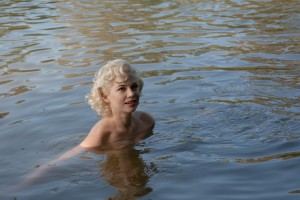
 Williams, who has Monroe’s signature wiggling walk down to a t, also displays her playfulness and emotionality in two brief nude scenes. With the helpful direction from Curtis, she portrays Monroe as skinny-dipping and embracing life with wild passion one minute and reclusive the next. Williams majestically carries Monroe’s confidence in sexuality and her sensitivity to the world to an audience nearly 50 years after her death.

Milton Greene (Dominic Cooper), Executive Producer of The Prince and the Showgirl, and Monroe’s ex-lover, says of her work, “When Marilyn gets it right, you just don’t want to look at anyone else.” This is true of Williams as Monroe as well. The character is so breathtakingly dynamic that scenes without her fill the audience with anticipation of her return to the screen.

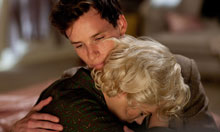
Redmayne as Clark is on point too. Clark’s eagerness on Olivier’s set shines through his green eyes and freckled face, adding to the innocence of the youth he is portraying. Though Clark and Monroe share a few kisses, and Clark undoubtedly falls under the goddess’s charm, their friendship can hardly be considered an affair. Clark, though years younger than Monroe, is in a position to see both sides of the situation and serves mainly as the paranoid actress’s confidant.

However, the film does stray from Clark’s memoir. It is not as honest — perhaps to add more detail to the account. In his memoirs, Clark did not want to fall in love with Monroe. He dawdled between wanting to save the melancholy star and attempting to keep his distance. While they shared a kiss or two, he insisted with Monroe, himself, and everyone around him that they were friends and nothing more. The film sugarcoats the story, portraying Clark as more of a puppy dog around Monroe; completely captivated and nearly helpless under her power, he tries to convince her to leave Hollywood for his love.

My Week with Marilyn focuses on a side of Monroe that documentaries often miss—her innocence, her desperation to be taken seriously as an actress, and the control the film industry attempted to exert on her personal life. The film does not delve into her psychological issues, but focuses on the blip she was in Clark’s life—a short week of Monroe’s warmth, spontaneity, and breakdowns.


Rating: 3.5 out of 4

Thursday, December 1, 2011

25 Things You Didn't Know About 'The Prince and the Showgirl'

By Gary Susman (Subscribe to Gary Susman's posts)
Posted Dec 1st 2011 8:30AM


How much of the backstage drama depicted in the new Michelle Williams film 'My Week With Marilyn' -- which chronicles the tumultuous shoot of the 1957 Marilyn Monroe/Laurence Olivier romantic comedy 'The Prince and the Showgirl' -- actually happened? Quite a bit, according to various Monroe and Olivier biographies. If anything, the new movie understates the turmoil surrounding the notoriously insecure and unreliable yet charismatic and witty sex goddess, her frustrated co-star/director Olivier, her overwhelmed new husband Arthur Miller, her manipulative drama coach Paula Strasberg, and star-struck gofer Colin Clark (on whose memoirs 'My Week with Marilyn' is based). It's no wonder that the action behind the camera is better remembered today than the finished product, which plays like a pleasant but inessential trifle, a footnote in the careers of two of the greatest performers in film history. Read on to learn more about what really happened behind the scenes of 'The Prince and the Showgirl,' including events not mentioned in 'My Week with Marilyn.'

1. 'The Prince and the Showgirl' was to be the first movie made by Marilyn Monroe Productions, the independent company she had formed with photographer-turned-paramour-turned-platonic-business-partner Milton Greene. The company had acquired the rights to Terence Rattigan's London stage hit 'The Sleeping Prince' as a vehicle for Monroe to prove her serious thespian bona fides, although it didn't stray too far from her roots in light romantic comedy. She'd made the deal with Rattigan herself, meeting him for drinks in a downtown New York bar before his trip to Hollywood, where he'd receive a nibble but no firm offers.

2. The obvious choice for both star and director was Olivier, who had originated the role of the Carpathian prince in the London version opposite his wife, Vivien Leigh. Many other alumni of the stage version would work on the film as well, including Jeremy Spenser and Richard Wattis, who reprised their stage roles, and set designer Roger Furse.

Excerpt from 'The Prince and the Showgirl'


3. Olivier was considered the greatest actor of his generation and one of England's biggest stars, but in 1956, pushing 50, he felt his film career was in a rut. He thought that Monroe's freshness and glamour would rub off on him and rejuvenate him.

4. Monroe and Olivier announced plans to make the movie at a February 1956 press conference in New York City, a Q&A session whose biggest revelation was a wardrobe malfunction in which a shoulder strap on Marilyn's backless black dress broke. Cynical reporters accused her of rigging the strap to snap on purpose, a charge she denied. But even Olivier believed it was a stunt. In any case, the broken-strap incident was memorable enough for Olivier and Monroe to turn it into a gag in a scene in the film.

5. Monroe and Miller had been married for just two weeks when they came to London for the shoot. They had left America at a time when Miller was under threat of indictment for contempt of Congress for his refusal to name suspected Communists to the House Un-American Activities Committee. Days after their arrival, Congress voted to cite him for contempt, a citation that would ultimately lead to a trial the following spring, after the Millers had returned to America. The playwright was ultimately fined $500 and given a suspended sentence of a month behind bars. The conviction was overturned on appeal a year later. Meanwhile, Olivier and Monroe had inserted an in-joke about "un-Carpathian activities" into their film.

6. Two days before Monroe's arrival, Leigh, 42, announced she was expecting a child in December. Three weeks into filming, however, Leigh miscarried. That tragedy put a new strain on the Oliviers' fragile marriage.

7. Greene brought along a young assistant, David Maysles, effectively launching the young man's movie career. Years later, David and his brother Albert would become giants of the documentary, with such films as 'Gimme Shelter' and 'Grey Gardens.'

8. Colin Clark landed his job as third assistant director because his parents were friends of the Oliviers.

9. Monroe's Method training, which made her feel like she needed to delve into the motivation for every line and gesture, led to clashes with Olivier and his classically-trained, just-do-it actors. She felt inadequate among them, despite having studied the Method herself for years with famed drama teacher Lee Strasberg. Asked by a British reporter what had inspired her to start studying acting, she replied, "Seeing my own pictures."

10. Lee's wife, Paula Strasberg, came along as Monroe's acting coach and earned a higher salary than anyone else on the project except the two leads.

11. Olivier sought advice from other directors who'd worked with Monroe on how to handle the difficult actress. Billy Wilder's advice: Just put up with her; the results are worth it. Joshua Logan, who visited the set late in the shoot, told Olivier: Work closely with Paula Strasberg and Monroe in rehearsals but don't let Strasberg on the set. But that proved impossible as Monroe simply refused to work without her coach by her side.

12. Typical Strasberg advice to Marilyn: Olivier spent a morning trying to inspire in Monroe the wit and sparkle needed in the scene when their characters first meet. Strasberg told her, "Honey -- just think of Coca-Cola and Frank Sinatra."

'The Prince and the Showgirl' - Trailer


13. Monroe's frequent tardiness, inability to remember lines, and her insistence on having every direction of Olivier's reinterpreted by Strasberg led to numerous production delays. One scene, in which Monroe's character eats caviar, took two days, 34 takes, and 20 jars of caviar to complete.

14. Olivier displayed his anger by being patronizing. "All you have to do is be sexy, dear Marilyn," he said, demoralizing Monroe, who was trying to break out of sex-symbol status and be taken seriously as an actress. Off the set, he complained that trying to give her direction was like teaching Urdu to a marmoset.

15. Sybil Thorndike, the venerable actress who played the Dowager Queen, urged Olivier and the other actors to be patient with Monroe. "We need her desperately," Thorndike said. "She's really the only one of us who knows how to act in front of a camera!"

16. In addition to babysitting the star (including during her free time, as depicted in 'My Week With Marilyn'), Clark was also tasked with keeping cigarettes on hand at all times for Olivier to smoke, since the actor/director's costume had no pockets. He smoked Oliviers, a brand named after himself.

17. Monroe turned to her new husband for moral support, often distracting him from working on rewrites of his play 'A View From the Bridge,' which was having its London premiere. He'd expanded it from one act (as it had premiered on Broadway) to a full-length, two-act drama. There were censorship complications over the play's hints of homosexuality that led the producers to move it to another theater. When it finally premiered that fall, the Oliviers and Millers attended opening night together in a gesture of solidarity, with Monroe wearing a striking red dress that ensured enthusiastic press coverage. The play was a hit.

18. Here's how Miller assesed the 'Prince and the Showgirl' shoot:
Olivier was soon prepared to murder Paula outright, and from time to time, I would not have minded joining him, for Marilyn, a natural comedienne, seemed distracted by half-digested spitballed imagery and pseudo-Stanislavskian parallelisms that left her unable to free her own native joyousness. As for Olivier, with all his limitations in directing Marilyn -- an arch tongue too quick with the cutting joke, an irritating mechanical exactitude in positioning her and imposing his preconceived notions upon her -- he still could have helped her far more than Paula with her puddings of acting philosophy.
19. It was during his time in England that Miller began writing the short story that would become 'The Misfits,' which would be the last film Monroe would complete.

20. Despite the countless production delays, Olivier finished the shoot a few days ahead of schedule. Still, he was said to be so shattered by the process that he didn't direct another film for 14 years (when he shot 1970's 'Three Sisters'), though he remained in demand as a stage and screen actor.

'The Prince and the Showgirl' poster21. Warner Bros. changed the title 'The Sleeping Prince' to 'The Prince and the Showgirl' to play up the presence of Monroe, the movie's chief box office draw. The film was advertised with a poster of Olivier and Monroe locked in a steamy embrace, a clinch that doesn't actually appear in the film. Despite these efforts, the movie earned mixed reviews and was considered a box office disappointment in America. In Europe, however, critics were kinder, and Monroe even earned awards for her performance in France and Italy.

22. Monroe and Greene's partnership dissolved in bitterness. She didn't work again for another two years, until she made her triumphant comeback in 'Some Like It Hot.'

23. Years later, Olivier admitted that the tribulations of working with Monroe had been worth it. Thorndike had been right; the camera had captured only Monroe's magic, without any of her doubts and frailties. "No one had such a look of unconscious wisdom, and her personality was strong on the screen," Olivier said. "She was quite wonderful, the best of all."

24. 'The Prince and the Showgirl' was the only movie Monroe filmed outside North America.

25. Rattigan's play also became a Broadway musical in 1963, called 'The Girl Who Came to Supper.' Noel Coward wrote the songs. The stars were Florence Henderson and José Ferrer. The show ran just over 100 performances, perhaps because Ferrer, while a terrific actor, was no Olivier, and Henderson (who was no longer an ingenue but not yet Mrs. Brady) was no Monroe. But then, who is?

[Photos: Warner Bros.]
Moviefone


Follow Moviefone on Twitter
Like Moviefone on Facebook

Follow Gary Susman on Twitter: @garysusman

Friday, November 25, 2011

Eddie Redmayne: The rising star chats My Week With Marilyn, keeping tabs on his peers and crossing the pond.


Friday, November 25 2011 16:5911 GMT

 
Having already established himself on the theatre circuit, Eddie Redmayne is set to become one of British cinema’s most distinctive faces. Before appearing in Abi Morgan’s Birdsong next year, Redmayne can be seen in My Week With Marilyn, in cinemas November 25, as Mrs Monroe’s wide-eyed assistant Colin Clark during the production of The Prince and the Showgirl. LWLies sat down with Redmayne at an East London coffee shop recently to discuss his career trajectory.

LWLies: You’ve been back and forth between the US and the UK recently, been to any good festivals in that time?
Redmayne: I don’t get to go very often. Do you get out to many festivals?

LWLies: A few. Cannes for a couple of weeks in May, handful since.
Two weeks! Bet you came back and needed a holiday…

Something like that. What about you, do you find yourself wanting to go to more and more festivals?
Redmayne: Yeah but to be honest I find that side of it a bit of a clusterfuck. But I went to Toronto with a film called Hick. It’s by a guy called Derick Martini and it’s basically about this little girl in Nebraska who comes from this white trash family. She’s 14 years old on that weird cusp of adolescence, and she has fantasies of going to Las Vegas and becoming a celebrity. And so she runs away from home and gets picked up by – in a slightly heightened Wizard of Oz fashion – by this Texan cowboy with a limp, which is what I play, who seems nice enough… You pretty promptly realise that he’s not all there and she winds up getting chucked out of his car and finds herself pairing up with Blake Lively’s character, this white trash meth addict. My character, who’s called Eddie, comes back and develops this weird kind of friendship with her that turns sinister.

It was an amazing experience because Chloë Moretz plays the girl and she’s fucking formidable and so much fun to play alongside. She’s this weird hybrid of being like… there’s nothing about her that’s like, ‘Oh, it’s just the fluke of youth’, you know, she’s a serious actress, but she’s also a 14-year-old girl. Here, in England, I do a lot of theatre and period pieces and it’s fun to have another life over there.

You’re fairly well known over here, particularly on the theatre circuit. Is it fun escaping to somewhere where you’re still something of an unknown entity?
In the States as an actor when you arrive no one knows what you do, because you’re English, it’s tough for people to put you into a casting bracket, which is what American producers love to do. They put you up for everything, so in the States I’ve gone from Savage Grace playing a very wealthy, gay young man to playing a limping Texan meth addict. That’s what’s fun for me… whereas so much of our industry is period drama driven or casting to type, it’s a release for me to scare myself and challenge myself. It can be terrifying, but it makes you stretch the parameters.

And you into acting through the theatre circuit?
I did, I did it a lot at school and really enjoyed it, and then when I was university it was the four hundredth anniversary of Twelfth Night and the Globe theatre were looking for a young guy to play Viola. I did a lot off the back of that and got an agent and it was one of those things that I loved doing but didn’t really ever know whether you were really allowed to do it professionally. So I took a year off after uni and gave it a shot. I started in theatre because that was all I knew, and it’s been exciting for me to stumble into other aspects of acting.

Has it felt like a quick transition to the screen?
It’s interesting because I sort of feel that but then I actually look back on it and I started in 2004 and it’s been six or seven years, you know. And it’s been a massive learning curve, particularly with film. The culture over here is that you go to drama schools, agents come to the drama schools and you’re then working in television and theatre and then you get a break and maybe go to America. Whereas in America it starts more in the commercial world, doing ads and TV, so I think that British actors, much more than American actors, have to learn film acting. Most of us start in theatre, and it’s a very different thing. You try to learn through the people you work with.

Let’s talk about My Week With Marilyn. You play a guy named Colin Clark…
That’s right. Alan Clark, the politician was Colin’s brother, and their father was a man named Kenneth Clark, one of the great art historians, an incredibly eccentric chap. They were new money, but they lived in this amazing castle in Kent called Saltford Castle, they were very bohemian and because of that artistic background the family hung out a lot with Margot Fontaine and Laurence Olivier and Vivien Leigh. What’s interesting is that Colin Clark went to Eton and had a very privileged upbringing but, at a time when everyone at Eton was fishing and shooting, here was this art historian’s son who never quite fitted in with his public school background. He was surrounded by these massive characters, and as a pretext that lead to him working in the film industry.

Through his parent connections he got a job as a runner on this film The Prince and the Showgirl, and it’s extraordinary because in one sense you’re the lowest of the low but at the same time you’ve got unprecedented access with the talent. You’re privy to conversations far beyond your status. So this film, Prince and Showgirl, was meant to be the meeting of the greatest actor in the world and the greatest film star in the world, both of whom wanted what the other one had; Olivier wanted to be a movie star and Monroe wanted to be taken seriously as an actress. In theory it was perfect but in practice it was a complete disaster, and her behaviour is well documented as being incredibly late the whole time – despite it being her money that was funding the whole thing – doped up to the nines on sleeping pills after having just married Arthur Miller and having by all account quite a rough time with him. It’s not a classic but it’s worth having a look at.

Everyone on set hated her because she was always late; there was a massive animosity towards her from the British crew. Yet despite all this there is no question that she steals the film whereas Olivier looks kind of mannered and stilted. So I think within the story the crew and everyone found her excruciating, but this guy, in getting so close to her, saw that her behaviour was influenced by what was going on in her private life. Having been brought up around all these people in this privileged youth he wasn’t intimidated by her and ended up having this one week of seeing through all the bullshit. And because he was so different from her she used him as a cipher by which to have a moment of breathing space, and he probably fell in love with the notion of what that was.

How much time did you spend with Michelle [Williams] during pre-production?
We had met in New York beforehand where I was doing a play and she was in London after. We had a limited rehearsal process and she was a lot busier than I was during that time.

When you’re playing such a famous figure you need to get every aspect of them spot on, whereas Colin is unknown to the audience…
Exactly. What was odd, though, was in one moment when his son and his wife and twin sister arrived on set. It must have been very odd for them to see me attempting to play their loved one. Michelle and Kenneth [Branagh] – playing Olivier – had it particularly tough but in some ways, although I was playing a real person, it was difficult finding the character.

You mention about doing more period stuff in the UK, which is influenced a lot by audience tastes being cultured towards certain trends, but is that something you’d like to step away from long-term?
You know what, I’ve had it incredibly good so far… I love the variety of having a schedule like Marilyn, Birdsong and Hick, I love the fact that you can do those types at films in quick succession. I don’t feel like I have to carve out a niche, or exclusively do film over theatre, but at the same time I’m not against working on similar projects. Everyone asks what I prefer, and I suppose I do like variety, but both film and theatre feed each other. What was interesting for me after establishing myself in the theatre was going away for four years and just doing film and then coming back and doing theatre again. It’s intimidating, but the film work really informed the later theatre work I did, much more so than the other way around, I would say.

When you reach the point where you’re constantly being labelled a ‘rising star’, do you become more aware of your own trajectory?
It’s interesting… I was talking to someone about it the other day… In Hick, you don’t see it onscreen but I end up raping a 14-year-old, and that’s heavy stuff, in the same way that Savage Grace was about incest. People’s reactions are always the same: ‘Ah, what bold choices…’ That always interests me because for me they don’t feel like bold choices because they’re really interesting, well-written parts. If I read a script and a character jumps out and it’s not exploitative, perhaps just pushing taboos, then there really is no question in my mind as to whether it’s the right choice. The one thing I think you begin to become more aware of is where your physical attributes will push you.

In some ways… You don’t let that limit you, but sometimes I get sent scripts that are kind of inappropriate and I can see where I’m trying to be positioned. And you’ll go along for the ride, maybe, but not pretend that it’s ultimately feasible. To give an example of it working in my favour, the Moretz family saw Savage Grace and felt quite strongly that I’d be right for the part in Hick. So when I got that script I wasn’t surprised, having done a film about incest, that I was being approached. That being said, the characters are such polar opposites. That’s what liberating, being sent scripts by producers who aren’t intimidated by hardcore subject matter.

Informally you’re part of a group of up-and-coming British actors making waves in the States right now. Is there a sense within that group of having made it?
Yeah. Well… Working and spending time in the States, it’s interesting to see the group of actors and actresses from my generation, who all started around the same time, getting so much respect. It’s wonderful, and at some point I’d love to work with some of my mates in that capacity, because it’s exciting, having started off as jokers trying to get a gig, thinking that our paths could meet.

Who are we talking about, exactly?
Dom Cooper, Andrew Garfield, Ben Whishaw, Charlie Cox… We’re not best mates, I’d say more close peers.

Sure. Is there an element of competition within that group?
Well we all go up for the same parts, and have done for years, and sometimes someone will land an extraordinary part that pushes them to a new league. But the answer is that it always will always remain competitive, but what we’ve learned to do is support each other. If I don’t get a part I think, ‘fuck’, of course, but if someone I respect and admire gets it… that kind of makes it easier to take. Interestingly I think that’s easier for men than it is for women, because there are fewer parts for women and it’s even more to do with looks. I often thank myself that I’m a guy.

For some female actresses the rise can seem very sudden, and the shelf-life short…
You’re often told as an actor, even when you’re a kid, that 99 per cent of actors are unemployed and it’s an unrealistic career path. But even if you’ve got support – and my parents were incredibly supportive – you’re always aware of that statistic and you never believe you’re ever going to make it.

Is there ever a point when you feel like you’ve made it?
You never feel that, really. I’ve just been looking around today trying to buy somewhere and although I’ve got a certain amount of money set aside, as an actor, even if you’ve worked consistently, banks are wary of giving you loans because effectively you’re self-employed. It’s not sustainable, but because you’ve always been told it’s never going to work you never feel like you’re never going to get another job again. It might sound ridiculous, because obviously I’ve been incredibly lucky so far, but when I’m looking for a house at the same time I’m seeing it as a huge risk because I‘ve got this insecurity that I’m never going to work again ingrained deep within my mind. You have to ask yourself whether you would ever consciously do ‘bad’ work just to keep living, and obviously some actors have lavish lifestyles so that’s an inevitability, because it’s incredibly rare to have long-term success.

Someone like Andrew Garfield though must surely be set for the next few years off the back of a big film like Spider-Man?
Well that’s the thing – when you do a big great film that earns a lot of money it feels like you might be set up for the short-term. But the thing to remember is that there aren’t that many movie stars around today, not in the sense of the Tom Cruises and Brad Pitts. Nowadays financing a film is very different, so I think there’s guys like Andrew and Rob Pattinson and Shia LaBeouf who can get a film financed, but that’s kind of it. Andrew’s very passionate about Spider-Man, but it gives him a freedom in that he can now go and do theatre or something smaller, independent. I often think that those big films are dangled in front of young actors affixed with a three-picture deal, but they don’t always come off. It’s risky. I love fucking watching those films, as well, I see ‘em all… and so as much as I want to do serious work, it’s exciting to be able to able to do fun stuff, the kind of films you grew up loving.

What do you love about movies?
What was one of the most interesting things about Marilyn was the film-within-a-film concept. And also the fact that it’s part of this British heritage – The Prince and the Showgirl was filmed in Pinewood and we shot it in the same studio; Michelle was in the same dressing room that Marilyn was in; we shot in the same corridors. While we were there Pirates of the Caribbean 4 was shot in the next lot over and there were all sorts of bedraggled pirates wandering along the corridors, and Chloe was actually there doing Hugo and so you’d see a load of French people in the dressing room… There are thousands of people working on completely different types of movies, and that pirate is walking the same corridors that Marilyn Monroe walked. Then you’ve got Ken Branagh strutting around dressed as Olivier and then running off at night to edit Thor via Skype. That’s fucking amazing. That sense of heritage really struck me. It’s very British not to over-celebrate what we do, but we have an amazing history and it was a wonderfully romantic feeling looking back at that. I’m very proud to be apart of that.

LittleWhiteLies

Film Review: 'My Week with Marilyn': an utterly charming trifle

Movie review

"My Week with Marilyn," directed by Simon Curtis and starring Michelle Williams, Kenneth Branagh, Eddie Redmayne and Judi Dench, is an utterly charming film that tells the story of a week in Marilyn Monroe's life, while she was making the film "The Prince and the Showgirl," in London. "Marilyn" is playing at several Seattle area theaters.

Seattle Times movie critic
Related
Movie review 3.5 stars'My Week with Marilyn,' with Michelle Williams, Kenneth Branagh, Eddie Redmayne, Dominic Cooper, Philip Jackson, Emma Watson, Judi Dench. Directed by Simon Curtis, from a screenplay by Adrian Hodges, based on the diaries of Colin Clark. 99 minutes. Rated R for some language. Several theaters.
 
Marilyn Monroe had a voice that sounded like Champagne bubbles, a walk famously described by Jack Lemmon in "Some Like It Hot" as "like Jell-O on springs," and a smile that could melt sorbet. In the utterly charming new movie "My Week with Marilyn," Michelle Williams channels all of these in the kind of star turn that looks effortless; she floats through the movie, perfectly capturing Monroe's way of rhythmically whispering through a song, looking softly frightened when uncertain, and not strolling so much as delicately oozing across the floor. She's mesmerizing — just like the original.

Directed by Simon Curtis (whose background is primarily in British theater and television), "My Week with Marilyn" is based on a true story from the summer of 1956. Monroe and her new husband, playwright Arthur Miller (Dougray Scott), came to England for the actress to star in the comic film "The Prince and the Showgirl," directed by and co-starring Sir Lawrence Olivier (Kenneth Branagh). Determined to prove herself as an actress, Monroe arrived nervously armed with her Method acting coach Paula Strasberg (Zoë Wanamaker) — and, unfortunately, the prescription medications and alcohol to which she was already addicted. The cast and crew were dismayed by her erratic behavior, except for the 23-year-old third assistant director, Colin Clark (Eddie Redmayne), who saw only an irresistible, vulnerable creature, and who became Monroe's unexpected companion for a tumultuous, magical week. (The film is based on the real-life Clark's memoirs.)

Filmed in creamy sunshine — though Williams seems to create her own spotlight, and move at her own speed — and handsomely designed, "My Week with Marilyn" is a delightful trifle, dwelling more on its title character's joys than her sorrows. It's over quickly, just as you're still admiring Branagh's closelipped way with a line; Julia Ormond's sweetly melancholy Vivien Leigh (seeing dailies with Olivier — to whom she was married at the time — she's moved, sadly, by Marilyn's beauty); Emma Watson as an ever-so-slightly jaded young wardrobe girl; and Judi Dench as legendary actress Dame Sybil Thorndike, presented here as the kindest and gentlest of colleagues. ("First love is such sweet despair," she murmurs to Colin, understanding all.)

Did everything really happen quite this way, on that movie set long ago? Who knows, but it's lovely to think so.

Moira Macdonald: 206-464-2725 or mmacdonald@seattletimes.com

The Seattle Times

Wednesday, November 23, 2011

Judi Dench will reunite with Kenneth Branagh for an adaptation of Henning Mankell's novel, which the director hopes will include Anthony Hopkins in the lead role

Dench steps into Branagh's Italian Shoes


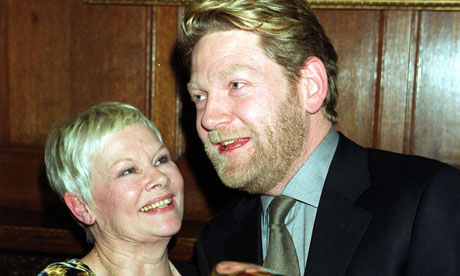
Treading the boards … Judi Dench and Kenneth Branagh in 2000. Photograph: William Conran/PA
After jostling for space on screen in My Week with Marilyn, Judi Dench and Kenneth Branagh are set to reunite for an adaptation of Henning Mankell's novel Italian Shoes.

Brannagh, who played a director – Laurence Olivier – in Marilyn, will step behind the camera for his version of the Swedish author's story. He hopes to cast Anthony Hopkins as Fredrik Welin, a retired orthopaedic surgeon who retreats to an isolated island, only to be forced back into human contact when an old girlfriend (Dench) comes to visit.

The film is "tailor-made" for Dench and Hopkins, according to Branagh. "The nuance, delicacy and flavour is so based on the perfect casting," he told Daily Variety. "[This casting] takes advantage of my long relationship with the pair of them."

Branagh has given Dench her marks before. She played Mistress Quickly in his directorial debut, Henry V, and later starred in Branagh's version of Hamlet. Dench in turn directed Branagh in Look Back in Anger, an adaptation of John Osborne's celebrated play that also starred Emma Thompson. Hopkins appeared in Branagh's last film, Thor, as the Nordic god Odin, ruler of Asgard.


The Guardian

Saturday, November 19, 2011

Eddie Redmayne: the loneliness of being a hot young actor

Michelle Williams's co-star in My Week with Marilyn is still getting used to sharing the limelight with Judi and Derek Jacobi. Now bring on the 'Redmayniacs'
Eddie-Redmayne
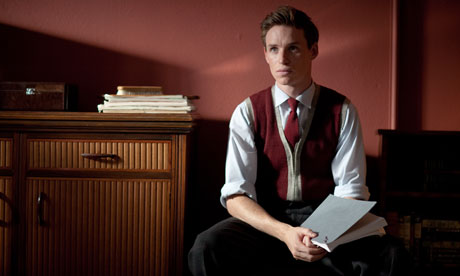
Eddie Redmayne in My Week With Marilyn.
 
Eddie Redmayne is rapidly shrinking into the slippery dark brown leather sofa upon which he sits, his head is disappearing under the neckline of his navy blue jumper, and his hands are raised ready to cover his ears. The cause of his discomfort? Me, sadly, as I read aloud some comments I've found on the various fansites dedicated to his very being. "Eddie: Flawless, ethereal, could 'get it' wearing tweed any day of the week," I read out to him.

"Wearing tweed?" he repeats in his very British accent, following it with a huge burst of laughter.
"Eddie is possibly the best human in the world," I continue, as he shrinks further. "Oh GOD!" "Eddie is so charming, and I am legit attracted to him."
"Legit?" he guffaws. "LEGIT?"

For those dedicated fans of Redmayne, 29, of which the most cursory search of the internet would indicate there are thousands, the end of this year is going to be a good one. It sees the release of My Week With Marilyn, an autobiographical account of the week Colin Clark (Redmayne), a recently graduated film obsessive, spent babysitting Marilyn Monroe in 1956 as she filmed The Prince And The Showgirl. It also sees the start of a stint at the Donmar Warehouse in Richard II. Further to that will be Birdsong, the BBC adaptation of Sebastian Faulks's best-selling book. After years of critical acclaim, winning both an Olivier and a Tony award for his performance in John Logan's Red (a play about Mark Rothko) at the Donmar and on Broadway respectively, as well as supporting roles in films alongside Julianne Moore (Savage Grace), Cate Blanchett (Elizabeth: The Golden Age) and Natalie Portman (The Other Boleyn Girl), it feels like Redmayne's "moment" has finally come.

'Michelle Williams and I were in most scenes and every day another bastion of the British establishment would come in'

Michelle-Williams Michelle Williams. Photograph: Allstar/Weinstein Company
"I see that there's a timing aspect of it all," he says, slightly squirming again (for an actor, he seems to find talking about himself relatively mortifying), "but any one of these things could collapse. I've found in the past that the critical reaction to a piece, if it's damned, will colour my memory of what the experience was. I had a wonderful time on Marilyn, a wonderful time on Birdsong and, hopefully, I'll have a wonderful time on this [he brandishes the yellow highlighter-heavy script for Richard II sitting on the table in front of him] so I'm trying not to think outside of that because it can pollute the experience."

My Week With Marilyn is undeniably Redmayne's highest-profile project to date. The cast reads like a Bafta fellowship guest list. Kenneth Branagh, Dame Judi Dench, Derek Jacobi, his friends Emma Watson and Dominic Cooper, and the piece de resistance, the lone American, Michelle Williams, as Marilyn Monroe. With his gentle disposition – the impeccable manners seem second nature rather than an actorly affectation – you rather wonder how Redmayne will cope with the spotlight. "The word 'buzz' worries me if I'm honest," he says, before pausing, and skilfully steering the conversation on to more familiar ground. "Michelle and I were there in most scenes and, every day, another bastion of the British establishment would come in and play opposite us; it was wonderful."

I bring up that it must have been an exciting prospect for him to act alongside Williams, having confessed in a past interview to being such a fan of … "Dawson's Creek!," he laughs. "That's coming back to haunt me, I should never have fucking said that. But she is extraordinary. She makes the part look effortless."

Since graduating from Cambridge in 2003 (he got a 2:1 in art history), Redmayne has worked almost constantly, playing paedophiles and boys who sleep with their mothers via the odd costume drama across film, television and the theatre. "What's really interesting about actors," he says, in that thoughtful, careful way that envelops all of his answers, "is that we all have opinions on how people's careers look, but I think you never have any idea of your own, or what other people think of you."
Marilyn sees him playing his most "normal" character to date. "I'm six years older than Colin," he agrees, "but I'm an Old Etonian, too. Weirdly, I found it just as challenging as playing the character I did in Savage Grace [the aforementioned mother lover]. What's been lovely is the variety of it all, and America has been very helpful for that. So much of our industry here is period drama, and given my background, that is what you slot into. But in America, because you're English, they send you off to everything because they can't bracket you. They'll go, 'Can you play an adopted native American Indian? OK, go audition for it, why not?'"

'You're by yourself for six months, and you're thinking: Oh God, I wish I could share it with someone'

MY WEEK WITH MARILYN
Redmayne is not from a clan of actors; he comes from a family of bankers, a world which he attempted to understand with a stint of work experience while at school. "It was the greatest feat of acting ever working there," he says, "having to pretend I knew what a share was when I didn't have a clue."

He's clearly far more at home in the acting world, but maybe there's a hankering for the 9 to 5. "I think all actors have a similar deal," he says. "You want some people who understand. Although it looks great – and is great – there are also shoddy moments when you feel really rotten, and when it's going well, you're not allowed to complain. Your actor friends will understand the nuances of a painful director, or the loneliness of being … OK, in a beautiful hotel room somewhere exotic. But you're by yourself for six months, and you're thinking, 'Oh God, I wish I could share it with someone.' I'm trying to buy a house and set some sense of roots because otherwise you're constantly chasing one job after another, and you look back and you've had all these very extraordinary experiences with extraordinary people, but there's not a line of continuity to it."

Perhaps one of his fans could fill the void the nomadic lifestyle creates? "I have this horrific thing where I'm really bad with names and faces," he grimaces. "I have an appalling memory. Someone will come up to me in the street and go, 'Eddie!', and I'll try and give myself time by going into overdrive, 'Hey, hi! Nice to see you!' and start a whole conversation because I can't distinguish between who I know and who I don't. My worst fear is somebody who I went to school with when I was eight coming up and me going, 'Sorry, who are you?' It's my worst nightmare."

So does he have groupies following him? "No," he laughs. "Benedict Cumberbatch is a mate of mine, and we did a charity show at the Old Vic together. There was this group of women outside the theatre who name themselves 'the Cumberbitches' and follow him round the world. I have nothing like that. I really wouldn't know what to do with the situation." Maybe, but with his "legit" attractiveness, appeal in tweed, and career explosion imminent, it's surely only a matter of time before those Cumberbitches (Redmayniacs?) come Eddie's way too.

The Guardian

Saturday, November 12, 2011

The Prince, The Showgirl, And the Stray Strap


Laurence Cendrowicz/Weinstein Company
Michelle Williams and Eddie Redmayne in “My Week With Marilyn.”

 
Bettman/Corbis
Marilyn Monroe holding the actual strap in 1956.
Warner Brothers Pictures
The telltale strap in scenes from “The Prince and the Showgirl,” starring Monroe and Laurence Olivier.

The scene was a news conference on Feb. 9, 1956, and about 150 “photographers, newsmen and news-hens in Manhattan’s sedate Plaza Hotel were scrambling to worm nearer to their common goal,” in Time magazine’s words.

Then Marilyn Monroe’s dress strap broke.

One news-hen, Judith Crist, The New York Herald Tribune’s film critic, remembers it well. “I was directly behind her, pushed against her by the largely male crush of reporters,” she said via e-mail. “ ‘There’s a ladies’ room to the right,’ I said, ‘I have a safety pin.’ ”

The news conference confirmed that Monroe and Laurence Olivier would star in a film version of “The Sleeping Prince,” Terence Rattigan’s play, which Olivier and Vivien Leigh, his wife, had originated onstage in London. Olivier would be the director; the title would become “The Prince and the Showgirl” to spotlight the twin star power.

The story of that difficult production is the subject of a Simon Curtis film, “My Week With Marilyn,” due later this month with Michelle Williams and Kenneth Branagh as Monroe and Olivier. It’s based on the memoirs of the filmmaker Colin Clark, who at 23 was third assistant director. But while “The Prince and the Showgirl” might have been filmed in Britain and might be concerned with coronations, curtsies and even Westminster Abbey, the story really begins in New York, site of that all-American wardrobe malfunction.

The Plaza news conference was Monroe’s first major appearance since she left Hollywood to study theater in New York and find more challenging roles. By 1956 she was seriously immersed in Method acting with Lee Strasberg at the Actors Studio and making plans to wed the playwright Arthur Miller. She was also serious about business. She negotiated a new contract with 20th Century Fox and started Marilyn Monroe Productions to engage in all forms of theatrical enterprise. “The Prince and the Showgirl” was the first (and only) independent film for the new company, of which she was president, and the vice president was the photographer Milton H. Greene. Her Fox contract had given her the freedom to develop her own projects. For “The Prince and the Showgirl” she negotiated a deal with the Warner Brothers chief Jack Warner and Olivier. Greene became the executive producer, Olivier the director and producer, Warner Brothers put up the money and served as distributor. “Last week there was persuasive evidence that Marilyn Monroe is a shrewd businesswoman,” Time reported in January, “apparent when Marilyn Monroe Productions bought a property to serve as a starring vehicle for its president, M. Monroe.”

She had pursued the deal by sidetracking the playwright Rattigan on his way to meet the director William Wyler in Hollywood. In a New York airport lounge on his stopover from London, Rattigan received a message from Monroe inviting him to join her for a cocktail. They met in a downtown bar where he could barely hear her whispery conversation, but he got her message: If Wyler wasn’t interested in the rights to his play, she was. According to Rattigan’s biographer, Michael Darlow, “She was prepared to write out a contract on the bar table there and then.” In Hollywood, Wyler made no definite offer; on the way back through New York, Rattigan accepted Monroe’s bid.

That February, two days before the Plaza conference, Rattigan, Olivier and Cecil Tennant, Olivier’s agent, met in Monroe’s Sutton Place apartment to drink Greene’s generous cocktails. They waited hours (reports vary on the exact length) for Monroe to appear, but when she did, they were in her thrall.

She was adorable, witty and incredible fun, Olivier wrote in “Confessions of an Actor.” Clearly, “I was going to fall most shatteringly in love with Marilyn.” (Once filming got under way, his feelings about Monroe’s desirability atrophied.) As they were about to leave, Monroe said in her “small voice”: “Just a minute. Shouldn’t somebody say something about an agreement?” By George, Olivier noted, “the girl was right.” And they arranged for a purely business meeting the next morning, then lunch at the “21” Club.

Marilyn Monroe was soon a daily news story. Rumors of her engagement to Miller brought phalanxes of photographers to her apartment. Then Miller was subpoenaed to appear before the House Un-American Activities Committee. On June 20 Monroe — keeping her mink coat closely held against her cheek so she wouldn’t be recognized — accompanied him to Penn Station, where he boarded the train to Washington. Once he was there, as Miller wrote in his autobiography, “Timebends,” his lawyer told him that the hearing could be canceled if Monroe agreed to be photographed shaking hands with the chairman of the committee. The offer was declined.

The next day Miller explained to the committee that he needed to go to England to see about a production of “A View From the Bridge” and “to join the woman who will be my wife.” As headlines summarized: “Playwright Talks of Reds, Marilyn.” In New York, Monroe issued a statement confirming their plans and hoping for a “quiet wedding.” Just two weeks after getting married, the couple flew to London, where production was to begin on “The Prince and the Showgirl.”

The story centers on Miss Elsie Marina, an American chorus girl (she says things like “your grand ducal”) who falls in love with an uptight Balkan prince. For the film the play was expanded slightly to include a reference to “Un-Carpathian Activities” and a scene in which the Prince Regent of Carpathia visits the cast of “The Coconut Girl” and meets Elsie,” whose gown strap breaks as she bows, whereupon a pin is called for. Whether Monroe’s strap-tease at the Plaza had been premeditated, “engineered in advance” (as Curtis Gathje writes in “At the Plaza”) or just an obliging snap, the eye-popping effect was duplicated in the film.

“The Prince and the Showgirl,” however, had an eye-closing effect when it was released in June 1957. Bosley Crowther wrote in The New York Times that the plot was thin, that “Sir Laurence is kept pretty much a stuffed-shirt” and that “Miss Monroe mainly has to giggle, wiggle, breathe deeply and flirt.”

After seeing the final cut Monroe sent Warner her analysis: “American audiences are not as moved by stained-glass windows as the British are, and we threaten them with boredom.” But her performance was hailed in Europe; she won awards in France and Italy.

And after her fictional meeting with a royal, Monroe met a real head of state: Queen Elizabeth II. Both were 30 at the time of their formal introduction in London that October.
The showgirl curtsied, and nothing but cameras snapped.
NY Times

Tuesday, November 1, 2011

Eddie Redmayne Joins Hugh Jackman In Les Miserables

Cinema Blend

Author Sean O'Connell
 
Eddie Redmayne Joins Hugh Jackman In Les Miserables image
Eddie Redmayne is about to make a splash with moviegoers once they seem him opposite Michelle Williams’ Marilyn Monroe in Simon Curtis’s Hollywood drama My Week With Marilyn. And much like War Horse star Jeremy Irvine, Redmayne’s parlaying his participation in an Oscar hopeful into a future gig in another prestige pic.

Deadline says Redmayne has signed on to The King’s Speech director Tom Hooper’s adaptation of the smash Broadway musical Les Miserables for Universal Pictures. He’ll play Marius opposite such high-powered co-stars as Russell Crowe (Inspector Javert), Hugh Jackman (Jean Valjean) and Anne Hathaway (Fantine) in a film that’s targeting a Dec. 7, 2012 release date.

These aren’t the only high-profile projects on Redmayne’s radar. A 20120 Tony Award winner for his performance in John Logan’s Red, Redmayne is also prepping a stage production of Richard II that opens Dec. 1 in London. And prior to his stage success, Redmayne made his silver screen debut in Robert De Niro’s CIA drama The Good Shepherd opposite Matt Damon and Angelina Jolie.

In Marilyn, which reaches theaters on Nov. 23, Redmayne plays Colin Clark, a non-Hollywood type who falls into a brief but passionate affair with Monroe while she’s filming The Prince and the Showgirl opposite Sir Laurence Olivier (Kenneth Branagh). He also appears in Derick Martini’s Hick with Chloe Moretz, which world premiered at this year’s Toronto International Film Festival. Needless to say, the young actor’s keeping very busy, and is making wise creative decisions that should only sustain his momentum on both stage and screen.

Wednesday, October 26, 2011

16 New 'My Week With Marilyn' Pictures Introduce You to the Whole Cast

Rope of Silicon


Everyone from Michelle Williams to Emma Watson

Brad Brevet
BY: 
PUBLISHED: WEDNESDAY, OCTOBER 26TH 2011 AT 1:54 PM
pictures from My Week with Marilyn
Michelle Williams in My Week with Marilyn


The Real Marilyn Monroe


No real comparison