Rose Williams in "Sanditon" (Photo: ITV Studios for Masterpiece)
Jane Austen’s final, unfinished novel Sanditon is heading to the small screen, courtesy of PBS’ Masterpiece and the U.K. network ITV.
This is the first ever adaptation of Austen’s incomplete last work, which she abandoned due to poor health just before her death in 1817. Only eleven chapters exist, but Emmy and BAFTA-winning writer Andrew Davies has expanded the story to fill eight hour-long installments.
Davies is also the man responsible for the – IMO, best – beloved adaptation of Pride and Prejudice that starred Colin Firthand Jennifer Ehle, so at least we know Austen’s work is in good hands, even if necessity requires some of its story elements to be made up out of whole cloth.
Rose Williams and Theo James in "Sanditon" (Photo: ITV Studios for Masterpiece)
Reign’sRose Williams stars as spirited young heroine Charlotte Heywood, an impulsive, joyous and optimistic girl who leaves her rural hometown of Willingden for the would-be coastal resort of Sanditon. Unfamiliar with the rules of high society, she discovers her confidence shaken, and her run-in with the prickly Sidney Parker does little to boost her self-esteem.
Will she be able to make her way in this world on her own terms, or will she find herself overwhelmed by the many intrigues in the seaside town?
The official website for BBC History Magazine and BBC World Histories Magazine HISTORY EXTRA
Descriptions of health, says author Bryan Kozlowski, run throughout the work of famed novelist Jane Austen – from the character of Mr Woodhouse inEmma to the health resort setting of her unfinishedSanditon. Writing forHistory Extra, Kozlowski shares four tips that can be found in the Regency-era writer’s classic novels, and what they tell us about contemporary attitudes towards healthy figures, women’s exercise and more…
While most of us have focused on the heart of Jane Austen’s novels or its portrayal of the society of the period, Austen herself was equally fascinated by something rather more functional: health. For some time now, I’ve been following the Jane Austen diet. Yes, you did read that correctly. To quote the character Mr Collins in the author’s Pride and Prejudice, “do not make yourself uneasy”. Because not only is the diet real, it’s been hiding right under our literary noses for more than two centuries.
It is incorporated into nearly everything Austen wrote, as this quote from Emma (1816) shows: “Where health is at stake, nothing else should be considered.” Themes of health are woven into her earliest stories; they continue strongly throughout Emma and Persuasion (1817); and are centre-stage in her last, unfinished novel Sanditon (set in a seaside health resort). Ironically, as Austen’s own health was fading [she died at the age of 41 after becoming ill with what is today thought to have been Addison’s disease], she wrote about cherishing true health even more.
In fact, look closer at her fiction and you’ll find that “improvement of health” has always been a part of Austen’s happily-ever-after package, freely bestowed on her most worthy characters, from Marianne Dashwood in Sense and Sensibility (1811) to Anne Elliot in Persuasion, who begins her own story a bit “faded” in the physical department. Yet to gradually regain one’s natural “bloom” is the birthright of Austen’s great and good. Even the word “health” itself pops up more than a hundred times in her six classic novels.
What Austen had to say about health and what science says today are astonishingly similar
Yet if Austen’s passion for doling out “secure and permanent health” is news to you, join the club; I only recently discovered it myself. Though interested in Jane Austen since adolescence it wasn’t until I neared my 30th birthday that I noticed something remarkable. What Austen had to say about health more than 200 years ago, and what science says today, is astonishingly similar.
The way her healthiest characters eat, exercise and think about their bodies can be seen to have unique patterns and modern parallels to heed. The discovery led me on a personal research project that has forever transformed my image of Austen – from ‘dowdy Hampshire spinster’ to timeless health guru with a sparkling wit. So, for lack of a better description, I’ve been on the Jane Austen ‘diet’ for more than two years now, incorporating wellness strategies found her in her writing into everyday life, finding new and fascinating ways to approach old body problems. Here are just a few of the many health lessons that Jane Austen advocated in her writing…
It’s Valentine’s Day 2019. Honestly, do you really need this intimation from us? Nope. Look around you, everyone is gripped by Valentine’s Day fever. Markets are flooded with greeting cards, flower bouquets and soft toys. People are buying roses and heart-shaped balloons for their loved ones.
Does not boast of a handsome face. Has a crazy wife locked up in his mansion’s attic. He is also moody, arrogant, cynical and jaded. That’s Charlotte Brontë’s hero (read: anti-hero) from Jane Eyre – Edward Rochester. Despite a long list of shortcomings, Mr Rochester sweeps the novel’s young heroine, Jane (as well as readers) off her feet. The brooding, difficult and secretive master of Thornfield Hall is not your ideal man. In fact, this Byronic hero is far from perfect. But despite all odds, you cannot stop from falling in love with him. Watch this "There Is No Debt" clip from 2011 movie Jane Eyre based on Bronte’s novel. It starred the very talented Michael Fassbender as Mr Rochester and wonderful Mia Wasikowska as Jane.
Fitzwilliam Darcy or Mr Darcy
Is it just me or has everyone been in search of their Mr Darcy (full name: Fitzwilliam Darcy)? The hero of Jane Austen’s Pride and Prejudice is your quintessential archetype of the aloof romantic hero. His pride makes the novel’s protagonist, Elizabeth Bennet outrightly reject his marriage proposal, and she declares him to be ‘the last man in the world’ she could ever be prevailed upon to marry! Ouch. Despite his pride and her prejudice, they continue to be drawn to each other. Jane Austen’s most favourite work has been adapted on many occasions, and you can relive Elizabeth and Mr Darcy’s chemistry with this short clip from 2005-film Pride and Prejudice. It starred Keira Knightley Keira Knightley as Elizabeth Bennet and Matthew Macfadyen as Mr Fitzwilliam Darcy.
It is a truth universally acknowledged that there’s nothing more swoony or hilarious than Hugh Grant and Colin Firth having an inept fistfight over everyone’s favorite verbally incontinent spinster.
But the famous brawl in Bridget Jones’s Diary between Daniel Cleaver (Grant) and Mark Darcy (Firth) — so beloved it even earned a retread in the 2004 sequel — only came after much deliberation. “We couldn’t think of a way to bring that end-of-act-2 climax. We spent ages on it,” director Sharon Maguire recalls to EW. “[Screenwriter] Richard Curtis said, ‘In Westerns and in the old days, it would have been a fight or a duel.’ We both thought, ‘Well, that’s it.’ Middle-class men fighting — they just don’t have a clue.”
The shooting script had few specifics, merely noting that “a fight ensues.” Maguire called in a stunt coordinator to choreograph, but Firth and Grant found that rang false, since their characters wouldn’t know any fighting moves. “I said, ‘Well, what would your characters do?’” Maguire says. “Then [Hugh] said, ‘Well, he would probably just bitch-slap him.’ And Colin said, ‘I’d probably kick him in a rather ineffectual way.’”
They ditched the stunt coordinator and let Grant and Firth infuse the scene with their own feeble attempts at violence. “We shot it with lots of action shots, but really the funniest bits were just the wide shots of them bitch-slapping each other,” Maguire says with a laugh. “All of it is the comedy of humiliation, really.” No stunt doubles were required, except for the final moment when the two crash through a restaurant window. (The stunt used sugar glass and was done in one take.)
Here, Hayley and Matthew tell TV Times about starring in the lavish new version of Howards End…
TV Times: How would you describe your characters?
Hayley Atwell: “Margaret has a wonderful warmth and is an eccentric character. She’s an independent thinker but she’s disillusioned. She feels she can talk about social affairs but not do anything about them, so she is searching for her place in the world.”
Matthew Macfadyen: “Henry’s one of those manly men of that time who isn’t prone to bouts of introspection or navel-gazing or talking about feelings. He’s very confident and pig-headed.”
What’s their relationship like?
MF: “Henry doesn’t have the tools that Margaret has to deal with the complex situations that arise; he gets frightened. They’re probably not a natural match, but she’s attracted by his self-possession and it’s a slow burn.”
HA: “Yes, they have a different set of values and it begins as something that isn’t rational and she doesn’t understand it herself. She has self-awareness and he is emotionally constipated but she ultimately finds that endearing because his intentions are good.”
How important is class to the drama?
MM: “Hugely and it’s just wonderful. It’s about sex, money, power, and how people operate in society and that doesn’t go out of fashion does it? It’s fantastic because you see everyone’s point of view.”
HA: “It brings up really interesting questions because you have capitalists with a drive for power and people at the lower end who are teetering on the abyss but know their place better than the Schlegels who are the wandering middle class. The novel talks about how we should “only connect” and that becomes Margaret’s message. She wants to connect everyone together so that things become classless.”
Daily Mail
Nicole Lampert For Weekend Magazine
PUBLISHED: 18:31 EDT, 3 November 2017 | UPDATED: 18:31 EDT, 3 November 2017
The setting is as splendid as you’d expect for the BBC’s latest costume drama.
Just outside the stunning stately home in the grounds of the picturesque, 5,000-acre West Wycombe Estate in the Chiltern Hills, there’s a marquee overlooking the lake.
Inside, it’s beautifully decorated with intricate winding flowers flowing from ornate Edwardian vases, and the table is laden with vintage crystal champagne glasses, along with decorative platters of fruit and cakes baked to the recipes of Victorian cook Mrs Beeton.
The table, and indeed the stage, is set for one of the most pivotal and dramatic scenes in the new adaptation of EM Forster’s novel Howards End – the wedding of rich businessman’s daughter Evie Wilcox to Percy Cahill at her family’s country estate, Oniton.
By the end of the reception, however, the three very different families the story centres on will have collided to disastrous effect.
And as the millions who’ve read Forster’s book or wallowed in the glorious 1992 Merchant Ivory film will know, what follows is destitution, tragedy, manslaughter and incarceration.
Despite Forster’s book being 107 years old, the themes still feel uncannily modern. The story revolves around three families in England at the beginning of the 20th century – the Wilcoxes, rich capitalists with a fortune made in the colonies, the half-German Schlegel siblings Margaret, Helen and younger brother Tibby, bohemian intellectuals who have much in common with the real-life Bloomsbury Group, and the Basts, an impoverished young couple from a lower-class background. Howards End, Mrs Wilcox’s beloved ancestral home – albeit a pile far less grand than Oniton – is almost a character in its own right too, becoming integral to the complex relationships between these three very different strata of society.
And this new four-part adaptation shows just how timeless, and at times brutal, the tale is.
‘Our series has been written to be deliberately not too earnest. In some ways it doesn’t feel like a period drama at all,’ says Hayley Atwell, who plays the central character of Margaret Schlegel in the drama, which has been adapted by American Kenneth Lonergan who won a BAFTA earlier this year for his film Manchester By The Sea.
‘We were all told not to watch the Merchant Ivory film because this was going to be very different. Despite the constrictions of the costumes and the period, we did feel we wanted to make it accessible to modern audiences by not making it feel mannered.’
Even Emma Thompson, who played Margaret in the 1992 film, told Hayley (who played Emma’s character’s daughter in the 2008 film version of Brideshead Revisited) not to refer to the Merchant Ivory version. ‘She said, “Don’t watch the film. She is you and you are she and she is you.”’
That’s not to say this lavish drama skimps on the things period fans love. There are plenty of corsets and bonnets, beautiful houses, high teas and even a former Mr Darcy in Matthew Macfadyen playing the businessman Henry Wilcox.
The filming of Colin Firth’s forthcoming disaster movie Kursk has been delayed after the Russian defence ministry failed to provide a permit on time.
According to the Hollywood Reporter, the Thomas Vinterberg-directed submarine drama was planned to begin shooting start next month but the review process has taken longer than expected.
“We haven’t yet received a permit from the defence ministry,” producer Andrei Sigle told local radio station Radio Baltika. “They probably have other things to take care of.”
Rather than move production to another country, such as Norway, Sigle aims to wait for a green light from the Russian government, who had initially promised cooperation. There have been suggestions that the defence ministry grew concerned over giving the crew access to classified locations and information.
You don't have to be a Hollywood insider to know that Tom Hardy is widely considered to be one of the most talented actors of his generation … and that he has a reputation for not always being willing to play by Hollywood’s rules.
Since making his onscreen debut in 2001, the London native has gone on to collaborate with some of the world’s most talented filmmakers, including Ridley Scott, George Miller, Alejandro González Iñárritu, Sofia Coppola, and Christopher Nolan (on three occasions, and counting). He also created, produced, and starred in the FX hit Taboo and earned an Oscar nomination for his role in The Revenant—and all of this before hitting the big 4-0.
1. HE WON A TELEVISION MODELING CONTEST.
Technically, Tom Hardy’s onscreen debut came in 1998, when he took part in a modeling contest on the British morning show The Big Breakfast. Among the facts we learned about the then-21-year-old: He was a drama student who idolized Gary Oldman, liked Eddie Izzard, wanted to write and direct his own short films, and didn’t like football. And yes, he won.
2. HE MADE HIS ONSCREEN DEBUT IN BAND OF BROTHERS.
In September of 1998, shortly after he began attending the Drama Centre London, Hardy dropped out when he was offered a role in the Steven Spielberg-produced WWII miniseries Band of Brothers (2001). When asked about the experience by IGN in 2002, Hardy said that, “Band of Brothers was my first job so I was virtually out of the frying pan and into the fire, really. I'd not had previous experience with working in front of the camera, so there was dealing with that. Also, I had the research material—not that I'd need it. I mean, I was in two episodes and had 12 lines. That was the sum total of work [I] had to do.”
Hardy made his big-screen debut in 2001 as well, playing Twombly in Ridley Scott’s Black Hawk Down. “I was the Ranger who got left behind,” he told IGN. “He was sort of, if you could call it, comic relief to [a] very precarious situation.”
3. HE WENT TO SCHOOL WITH MICHAEL FASSBENDER.
While attending the Drama Centre London, Hardy looked up to a fellow student who was two years older than him: Michael Fassbender. “He was a really serious method actor and we used to watch him and think, ‘F**k, man! He’s the sh*t!,’” Hardy told The Daily Beast. “He was in an Irish play about this guy who came back from the First World War who was a great athlete but ended up in a wheelchair, but at lunchtime he wouldn’t come out of character and was always in his wheelchair and we’d be like, ‘Dude! Just order your lunch and come along! We’ve got an hour before we have to go back to class! But he was the best actor in the school.” (Fassbender, too, landed a role in Band of Brothers.)
4. HARDY REPLACED FASSBENDER IN TINKER TAILOR SOLDIER SPY.
Though their careers have taken different paths, Hardy and Fassbender overlapped a bit in 2010, when Hardy replaced Fassbender as British operative “Tricky” Ricky Tarr in Tomas Alfredson’s 2011 adaptation of Tinker Tailor Soldier Spy, a Cold War thriller based on the John le Carré novel.
5. HE IDOLIZES GARY OLDMAN.
That aforementioned modeling contest wouldn’t be the only time Hardy expressed his admiration of Gary Oldman. In 2011, he told ShortList that, “Gary Oldman is my absolute complete and utter hero. He’s the f**king man. I look at him and I want to be like that for my generation—I want to have that same quality. He’s incredible.”
That same year, Hardy got the chance to star alongside Oldman in the Oscar-nominated Tinker Tailor Soldier Spy. “There is a definite ‘hang on a minute’ [moment], but I’ve got past the star-struck part now,” Hardy said of getting the chance to act opposite Oldman. They have since worked together on three more films: Lawless (2012), The Dark Knight Rises (2012), and Child 44 (2015).
Daily Mail
By Eve Buckland For Mailonline
PUBLISHED: 15:46 EDT, 7 October 2017 | UPDATED: 15:01 EDT, 8 October 2017
She has been hard at work on her latest film Berlin, I Love You.
And Keira Knightley looked content and happy as she strolled through Berlin Tegel Airport on Saturday.
The Oscar-nominated actress, 32, showed off her natural beauty as she went make-up free for her trip through the terminal, revealing radiant skin and sparkling eyes.
The star looked in fantastic spirits as she chatted with a pal, signed autographs and pulled a series of animated expressions.
Berlin, I Love You is an anthology film which tells 20 separate tales of love in the German capital.
Keira will star alongside stars including Jared Leto, Renee Zellweger and Orlando Bloom.
The British beauty combines her acclaimed career with motherhood to daughter Edie, now two, who she welcomed with Klaxons frontman James Righton in May 2015.
Colin Firth said he read the allegations against Harvey Weinstein ‘with a feeling of nausea’. Photograph: Stefano Rellandini/Reuters
Colin Firth has expressed his shame for not doing more when a British actor he worked with told him of “a distressing encounter” with Harvey Weinstein in a hotel room more than 25 years ago.
He spoke out after Sophie Dix, who starred with him in one of the first cinema movies he made, went public with details of an alleged sexual assault involving Weinstein.
“She told me she had had a distressing encounter with Harvey Weinstein,” Firth told the Guardian. “I don’t think she went into all the horrific detail I’ve read in her interview. But I remember her being profoundly upset by it. To my shame, I merely expressed sympathy.
“I didn’t act on what she told me,” he went on. “It was a long time ago and I don’t know if she remembers telling me, but the fact that I had that conversation has come back to haunt me in the light of these revelations. It’s the only direct account of this kind of behaviour by Harvey Weinstein that’s ever been told to me.”
DAILY MAIL
By Ryan Smith and Emily Chan For Mailonline
PUBLISHED: 09:14 EDT, 17 March 2017 | UPDATED: 09:17 EDT, 17 March 2017
With a black velvet hat resting atop her chestnut brown tresses, the actress got into character as she filmed with Matthew, who cut a dapper figure in a top hat and black waistcoat under a midnight blue coat.
Over the past week, they've been busy getting into character for their latest - and highly anticipated - project, which transports them back to Edwardian London.
And on Thursday, things appeared to be going swimmingly for Hayley Atwell and Matthew MacFadyen as they shot scenes along London's River Thames for the glamorous BBC adaptation of E.M. Forster's 1910 novel Howards End.
Hayley, 34, was appropriately dressed the era, stepping before cameras in a full-length brown coat, teamed with a red patterned scarf and flowing blue skirt.
The dark TV drama - already dubbed by some as the next Downton Abbey - explores the changing landscape of social and class divisions in turn of the century England through the tales of three families.
These are the intellectual and idealistic Schlegels, the wealthy Wilcoxes from the world of business, and the working class Basts.
British actresses Helena Bonham Carter and Emma Thompson previously starred in the 1992 film adaptation of the novel.
DAILY MAIL
Isolde Walters For Mailonline
PUBLISHED: 18:27 EST, 4 March 2017 | UPDATED: 03:32 EST, 6 March 2017
The iconic film was shot more than 13 years ago and almost all the stars are reuniting for a one-off Comic Relief sketch.
Colin Firth, who plays Jamie, was spotted on the set of the eagerly awaited Love Actually sequel at the BBC Langham Place Piazza in central London on Saturday.
The Oscar winner beamed as he reprised his character Jamie, the English would-be novelist who fell in love with Aurelia, his Portuguese housekeeper.
The Bridget Jones's Diary actor wore a comfortable grey knitted jumper and donned a pair of thick-framed spectacles as he rehearsed his lines and waved to the waiting photographers.
In the original film, Jamie is heartbroken after catching his girlfriend in bed with another man.
He moves to France to recover from the betrayal and write his novel. It is here that he meets Aurelia, played by Lucia Moniz, his Portuguese housekeeper.
Despite the fact that Aurelia cannot speak English and Jamie cannot speak Portuguese, he falls in love with her and the film follows their tentative romance.
FINAL SEASON OF RIPPER STREET, MARCH 8 ON BBC AMERICA (finally)
CHICAGO TRIBUME
By Emma Krupp
RedEye
David Oyelowo has grown weary of African warlords, and white saviors, and homogenized tales of a desolate, starving Africa.
“A lot of the films that we’ve seen in the past have been just that, whether it’s crowbarring a white protagonist into an African story or the lens through which African films have been made, often being white and male,” he said last week in an interview with RedEye at Chicago’s Peninsula Hotel. “It’s not that any of that is wrong, it’s just that we’ve had so much of it. And anyone who knows about eating food would know that a balanced diet is the way forward.”
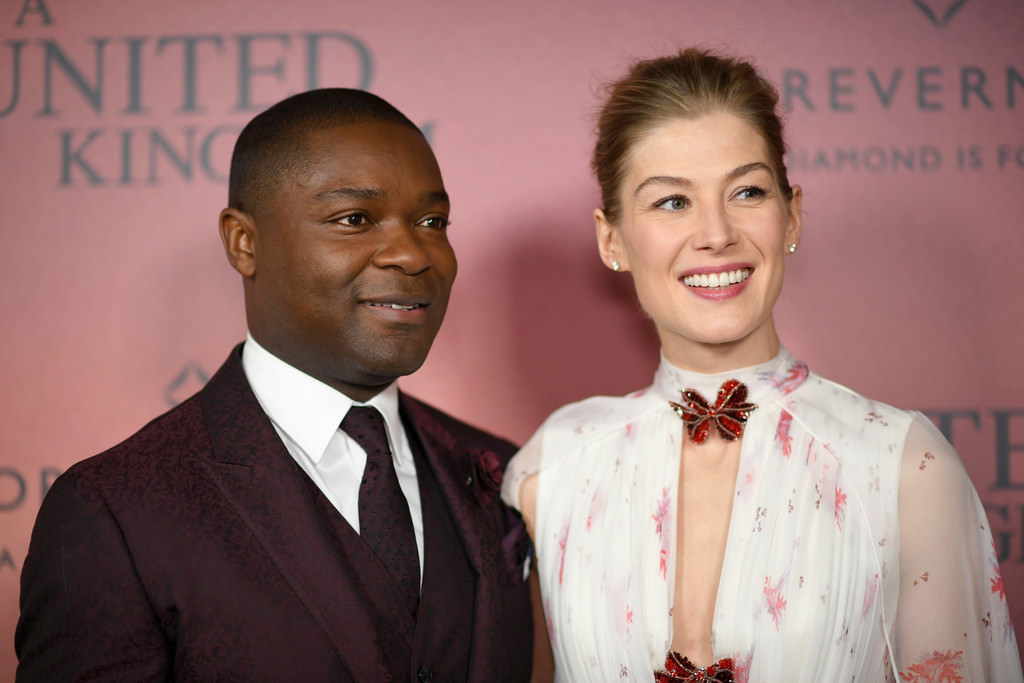
Oyelowo’s new film “A United Kingdom,” in which he stars as the king of Bechuanaland in modern-day Botswana, is exactly the kind of balanced portrayal of Africa he seeks.
Directed by the Ghanian-British filmmaker Amma Asante, “A United Kingdom” tells the true story of King Seretse Khama and his white, British wife, Ruth Williams (played by the ever-lovely Rosamund Pike), whom he fell in love with and married after meeting in the U.K. Despite international uproar and exile from his country, Khama refused to divorce his wife. He later abdicated the throne and became the first democratically elected president of Botswana.
In both “A United Kingdom” and real life, the love story of Seretse and Ruth transcends genres. For a high-profile interracial couple in the 1940s and ‘50s, being in a relationship meant living a politicized existence—facing the opposition of not just a parent or a community, but entire nations. And although Oyelowo knew “A United Kingdom” could never be a mere romance film, he wanted to narrow the story’s focus on the connection between the couple
“I think love appears in different forms,” Oyelowo said. “But true love, in any form, is—in my opinion—tied to sacrifice. The desire to give without the hope of getting back is the definition of love.”
Sacrifice is obvious in “A United Kingdom,” but Oyelowo sees the influence of sacrificial love in two of his more recent roles—Martin Luther King, Jr. in “Selma” and chess coach Robert Katende in “The Queen of Katwe.” Each film shows the lengths both men are willing to go in order to create a better life for others, even if that pursuit meant putting themselves and their families in danger.
“I think that’s love,” he said. “So I’m very much drawn to those type of characters.”
He may play a narcissistic, testosterone-fuelled baddie in Beauty and the Beast, but in real life, Luke Evans was bowled over by Emma Watson's "brilliant" portrayal of Belle as a "strong, 21st century woman".
The actor takes on brutish love rival Gaston in Disney's live-action adaptation, and speaking to Digital Spy on the set of Noel Clarke's upcoming thriller 10 x 10, he said: "I'm very proud of her achievement in the film - not just her singing ability, but how she's portrayed Belle, and how she's brought her into a 21st century, strong woman."
The Girl on the Train star has a background in musical theatre and explained that, while singing as Gaston wasn't easy, it was a "total joy" to accomplish.
"I wouldn't say it was easy singing as Gaston, but it was very enjoyable," he continued. "I love singing, and Gaston's songs are so great, and they're huge numbers, and so funny. It was just a total joy."
Meanwhile, Luke will star opposite True Detective's Kelly Reilly in Suzi Ewing's first feature-length film 10 x 10 - written by Brotherhood's Noel Clarke
Keira Knightley's former directors have come to the defense of the star after filmmaker John Carney criticized her acting.
Carney directed the Oscar-nominee in the music-themed 2013 film Begin Again, but in a revealing interview with Britain's The Independent newspaper over the weekend, he slammed Knightley for her alleged diva behaviour and lack of serious acting skills.
"Keira has an entourage that follow her everywhere so it's very hard to get any real work done," he told the publication. "And as much as I tried to make it work I think that she didn't quite come out as a guitar-playing singer-songwriter. I learned that I'll never make a film with supermodels again."
He added, "I don't want to rubbish Keira, but you know it's hard being a film actor and it requires a certain level of honesty and self-analysis that I don't think she's ready for yet and I certainly don't think she was ready for on that film."
His comments irked both fans and her former collaborators, including Mark Romanek, who directed Knightley in 2010 thriller Never Let Me Go.
He took to Twitter on Monday to defend the actress, writing, "My experience with #keiraknightley was utterly spectacular on every level. I have no clue what this guy is talking about."
He ended the post with pointed words aimed at Carney, adding, "#arrogants--thead".
My experience with #keiraknightley was utterly spectacular on every level. I have no clue what this guy is talking about. #arrogantshithead
— mark romanek (@markromanek) May 30, 2016
My recollection of #keiraknightley's "entourage" was that her mum visited the set one day for an hour or two.
— mark romanek (@markromanek) May 30, 2016
Meanwhile, Lorene Scafaria, the writer/director of Knightley's 2012 film Seeking a Friend for the End of the World, echoed Romanek's statement.
"I agree with Mark," she posted. "Keira was a joy to work w/ (with). Present & easy & really, really good at her job. Just lovely."
Helen Fielding exposed the world to her thirty-something protagonist in the 1996 novel Bridget Jones’s Diary. The popularity of the book across the population would lead to 1999’s sequel, Bridget Jones: The Edge of Reason, two films in 2001 and 2004 based on these works, another novel, Bridget Jones: Mad About the Boy in 2013, and a third film not based on that novel, Bridget Jones’s Baby in 2016. With the film adaptations, actress Renee Zellweger has become as synonymous with the character as Bridget’s creator has. If you want to know more about the books and films, read on.
Getting into Character
Before filming started, Renee Zellweger gained twenty-five pounds, put on a posh English accent, and started working in a real British publishing company. Surprisingly enough, very few of her new coworkers actually recognised her. Zellweger even kept a picture of then-boyfriend Jim Carrey on her desk, which employees who didn’t know her thought strange, but were too polite to say anything about it.
Friends in High Places
Salman Rushdie’s cameo in the first film was done as a favor to Helen Fielding. The two have been long-time friends and she called Rushdie to ask him if he’d be willing to embarrass himself on camera. He recently jokingly tweeted that he considers it his finest work.
Actor Paradox
As the first two books were written well before the films came out, both of them actually make references to Hugh Grant and Colin Firth. Of course, when they were cast in 2001’s Bridget Jones’s Diary, no reference to them is made in the film. In the books, Bridget is actually a huge fan of the 1995 Pride and Prejudice mini-series and gets to interview Firth for her television job.